What Radiometric Thermal Actually Measures
Every thermal camera makes a colorful picture. A radiometric one records a calibrated temperature for every pixel, which is the difference between "that unit looks hot" and "that unit is running 21°F above its twin." The first is an impression. The second is a finding a facilities manager, an electrical contractor, or an insurer can act on — and defend.
We fly radiometric sensors exclusively, and we report temperatures with the assumptions behind them stated: the emissivity used for the surface, the reflected apparent temperature, the ambient conditions, and the time of capture. Change any of those and the number changes, so a report that omits them is not a measurement. It is a guess with a color scale.
The other thing radiometric capture makes possible is comparison. Most thermal findings are not about an absolute temperature at all; they are about one component reading differently from the identical components around it. Fans on the same unit, breakers in the same panel, modules in the same string, bays under the same roof membrane. That relative reading is what isolates a fault from a warm day.
Where It Gets Used
Roofs and Building Envelopes
A radiometric payload does not care what it is looking at. What changes between a solar survey and a roof survey is the physics you are exploiting and the conditions you have to fly in.
On an array you are looking for something generating excess heat under electrical load. On a roof you are usually looking for the opposite — water. Saturated insulation and wet ballast hold far more thermal mass than the dry assembly around them, so they heat and cool at a different rate. Fly at the right point in that cycle and trapped moisture separates cleanly from sound roof.
Which direction the anomaly reads
This is the part most people get backwards, and it determines whether a survey is interpretable at all.
- After sunset, the dry assembly has already shed its heat while saturated areas are still releasing theirs. Wet areas read warm. This is the classic moisture survey and the strongest signal.
- During daytime solar loading, the elevated thermal mass and evaporative cooling of a wet area hold it cooler than the dry assembly around it. Wet areas read cool.
Both work. What does not work is failing to state which regime the survey was flown in, because the sign of the anomaly inverts between them — and a report that says "cool anomaly, likely moisture" without saying it was captured under solar loading is not auditable. Every finding we report carries the capture conditions with it.
What a roof survey actually finds
- Trapped moisture and saturated insulation — the primary target, quantified by approximate affected area rather than just flagged
- Membrane sagging and substrate deflection — differential heat retention where the assembly has moved
- Ponding around equipment curbs — condensate and runoff collect there, so it is a predictable failure location
- Seam and flashing failures — often tracking along a walkway seam or parapet
- Rooftop equipment under strain — the incidental finding that frequently pays for the survey
What a thermal roof survey will not do
It localises moisture; it does not confirm it. A cool or warm signature is evidence, not a core sample. We recommend physical verification by a roofer before any repair is scoped, and every finding is reported as consistent with a cause rather than as a diagnosis. Findings also reflect conditions on the day of the flight — a roof surveyed three days after rain reads differently from one surveyed three weeks after.
Electrical panels, switchgear, and connections
Resistance makes heat. A loose lug, a corroded connection, an overloaded conductor, or a failing breaker all run warmer than their neighbours under the same load, and they run warmer long before they fail. The survey is straightforward: image the equipment under normal operating load, compare like against like, and rank the exceptions by how far above the reference they read.
Two conditions matter. The equipment has to be energised and carrying meaningful load, because a de-energised panel is thermally silent. And enclosed gear has to be opened by qualified personnel for a direct line of sight — a thermal camera does not see through a steel door. For pad-mount transformers, outdoor switchgear, substation components, and rooftop disconnects, the aircraft covers in minutes what would otherwise be a lift and a ladder.
Mechanical and HVAC equipment
Rotating equipment tells on itself thermally. Bearings running dry, motors under strain, belts slipping, and compressors short-cycling all show as temperature differentials against matched components or against their own history. On a large roof, a single survey pass images every unit at once, which turns "we check the units on a rotation" into "we know which three need a technician this month."
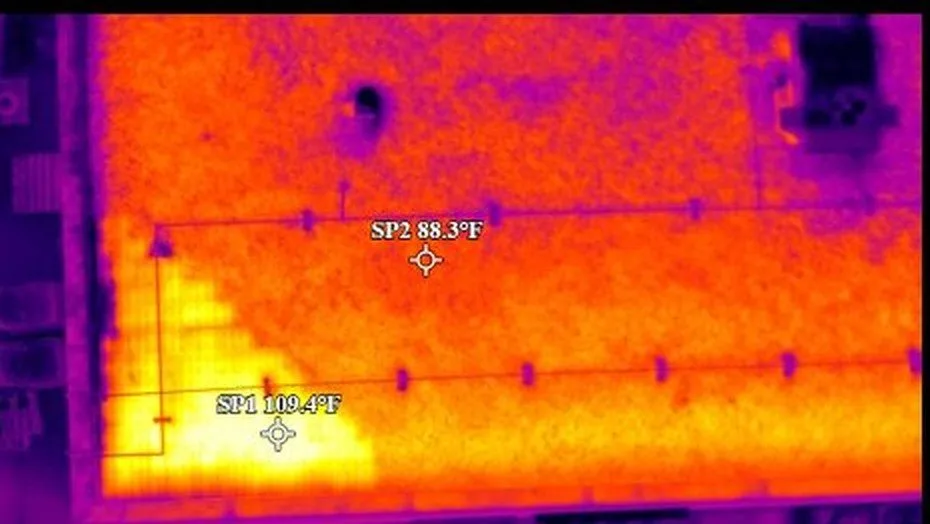
Two matched fans on one rooftop unit, both running at the time of survey: SP1 at 109.4°F against SP2 at 88.3°F. A sustained 21°F differential between components that should be thermally identical is a recognized early indicator of bearing wear, loss of lubrication, or motor strain.
That image is the argument for radiometric capture over colorized video. The finding is not "one fan looks hot" — it is a measured 21°F differential between two components that should read the same, on a unit nobody had flagged.
Solar arrays
Photovoltaic thermal inspection is its own discipline, with its own fault signatures, survey conditions, and reporting standard. Hot cells, bypass diode failures, string outages, soiling, and delamination each read differently, and the survey is only defensible when irradiance, wind, and time of day are recorded with it. We cover it in depth on the solar farm analysis page, including IEC 62446-3 reporting.
Utility and infrastructure components
Distribution connectors, insulators, capacitor banks, and substation equipment develop the same resistive heating as anything else electrical, and they are usually the hardest things to get a camera in front of. A drone survey along a feeder or across a substation yard images every component from the same standoff, under load, without an outage or a bucket truck.
How We Fly It
Thermal findings are only as good as the conditions they were captured in, so the conditions are the first thing we plan.
- Delta-T. For envelopes and roofs, we want a meaningful temperature difference between the assembly and the air around it — typically 18°F (10°C) or more — which usually means flying after sunset or at the tail of a hot afternoon. Without it, wet and dry read the same.
- Time of day and sky. Roof moisture surveys are flown after sunset under clear sky, when the dry assembly has released its heat. Electrical and mechanical surveys are flown during operating hours under load. Direct sun on a target is managed, not ignored.
- Wind and moisture. Wind strips heat from surfaces and flattens contrast; standing water and recent rain mask a roof completely. We hold the flight for a dry roof and calm air rather than deliver a survey that reads clean because nothing could be seen.
- Sensor and altitude. Radiometric thermal at an altitude that gives the pixel-on-target size the finding needs — a moisture blister and a lug on a bus bar are not the same target. A visual camera captures simultaneously so every thermal frame has a matching RGB reference.
- Capture regime recorded. Ambient temperature, sky condition, wind, time, and the emissivity settings used are written into the report, so the sign and size of every anomaly can be checked against the conditions that produced it.
Deliverables
- Annotated findings report — each anomaly located on an orthomosaic or site plan, with spot temperatures, the reference it was compared against, the measured differential, and a severity rank
- Radiometric image files — the original R-JPEG frames with embedded temperature data, so your own team or a third party can re-measure anything in the set
- Matched visual imagery — the RGB frame for every thermal frame, because a hot spot without context is a question, not an answer
- Capture conditions log — the time, weather, delta-T, and sensor settings behind every finding
- Verification recommendations — what should be physically checked, by whom, and in what order, stated as "consistent with" rather than as a diagnosis
Where Thermal Earns Its Cost
Thermal pays when the cost of the thing failing is high and the cost of looking is low: a commercial roof before a warranty expires or a building changes hands, a panel lineup before an outage window, a fleet of rooftop units before the cooling season, a substation before a peak-load month. It also pays as a screening tool — one pass across a large asset, then a technician sent to the handful of places that actually need one.
When We Will Tell You Not to Buy It
A wet roof, a windy week, or a de-energised panel will produce a survey that reads clean and means nothing — we will reschedule rather than fly it. A single small unit that a technician can reach with a handheld camera does not need an aircraft. And thermal will not tell you why something is hot, only that it is; if the question is root cause, the survey is the start of the answer and a qualified trade is the rest of it.
Further Reading
Thermal Roof Surveys: Does Moisture Read Warm or Cool? — why the capture window inverts the anomaly, and what a defensible thermal report has to record.
Solar Farm Analysis — panel-level fault detection across utility-scale and commercial arrays, reported to IEC 62446-3.