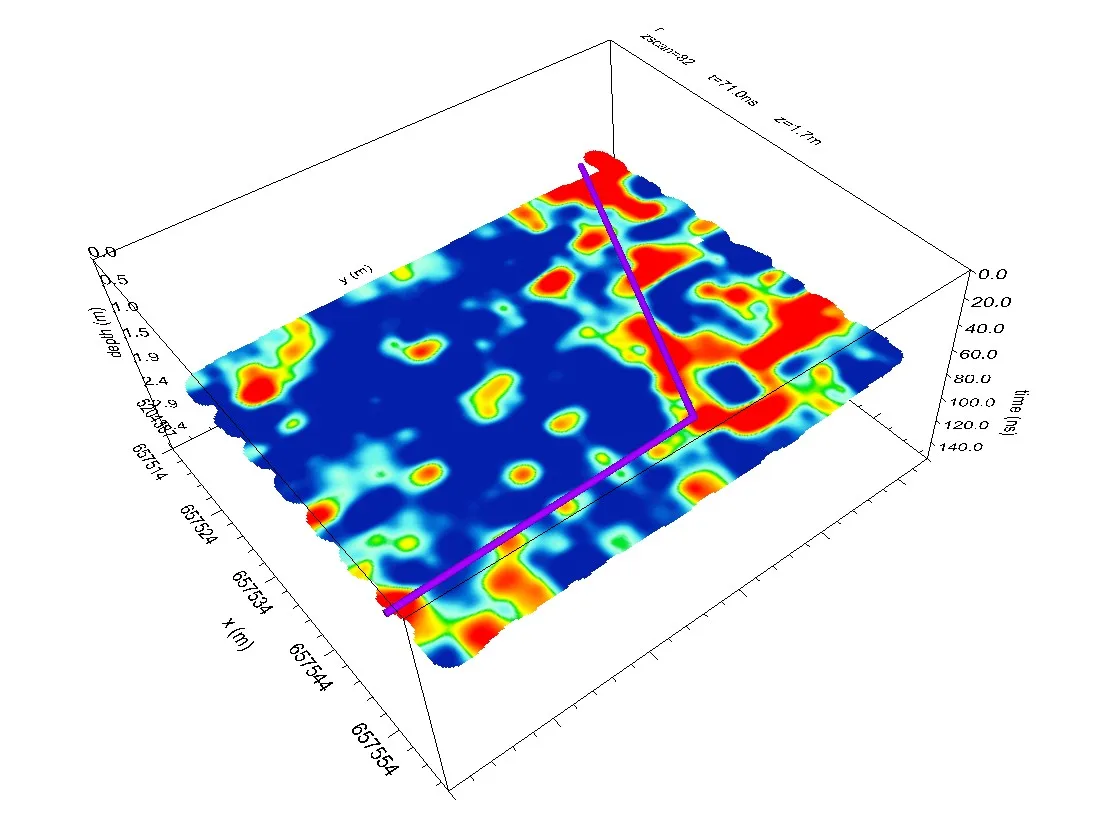
Utility Mapping First. Radar Second.
Nobody wakes up wanting a radar survey. They want to know where the lines run before the excavator finds out the hard way, whether the old as-builts can be trusted, how much cover is really left over the pipe, and whether the ground under a slab is solid or void. Underground utility mapping is that certainty, delivered as marks on the ground and mapped geometry your engineer can design against.
Ground penetrating radar — flown from a drone where the ground can’t be walked, surface-coupled where it can — is how we produce it. The aircraft is the differentiator, not the product: it reaches the flooded, unstable, planted, and protected ground where cart surveys stop.
An important boundary up front: the 811 one-call locate marks the public side — operator-owned facilities up to the meter. Everything past that point is private, routinely undocumented, and exactly where strikes happen. That private side is its own service: Private Utility Locating & SUE Support. For pipeline operators, cover verification along the right-of-way is too: Pipeline Depth of Cover Surveys.
Why Fly Ground-Penetrating Radar Instead of Pushing It
GPR has been a ground-based tool for decades. An operator walks a cart across the survey area, the antenna couples to the soil, and the radar images what is beneath. It works well and it is the right method on a parking lot or a building slab.
It stops working when the surface will not carry a cart or a person. Flooded ground, active landfill, unstable slopes, contaminated sites, dense brush, tidal flats, and suspected void or sinkhole areas all share the same problem: the place you most need subsurface data is the place you least want to send someone on foot.
Flying the antenna solves the access problem and introduces a different one. Airborne GPR loses the direct ground coupling that a cart provides, so signal strength and depth of penetration are reduced compared to a contact survey. Anyone who tells you airborne GPR matches ground GPR depth-for-depth is selling you something. What it does is make a survey possible where no survey was possible, and that is usually the comparison that actually matters.
How Depth Really Behaves
Penetration depth in GPR is governed by the material, not by the equipment brochure. The single biggest factor is electrical conductivity — and specifically clay and salt content.
- Dry sand, gravel, and granite are close to ideal. Signal travels well and useful depth is at the upper end of the range.
- Silt and loam perform moderately, with depth falling as moisture rises.
- Wet clay is the worst case. It attenuates the signal aggressively and can limit useful penetration to a fraction of what the same antenna achieves in sand.
- Fresh water transmits well, which is what makes GPR bathymetry viable. Salt water does not — conductivity kills the signal almost immediately.
Antenna frequency sets the trade. Lower frequency reaches deeper and resolves less detail; higher frequency resolves fine features and stops shallower. There is no setting that gives you both, and choosing wrongly wastes the mobilization.
The honest answer to "how deep will it see?" is that it depends on your ground, and the only way to know is to test on site. We would rather tell you that than quote a depth figure we cannot stand behind.
What Airborne GPR Is Genuinely Good At
Bathymetry over fresh water
Flying a fixed height above a water surface, GPR returns both the water surface and the bed beneath it, which yields depth along every flight line. This works in shallow, turbid, or weed-choked water where optical and green-laser methods struggle, and it needs no boat, no crew on the water, and no shutdown of adjacent operations.
Void and sinkhole reconnaissance
Voids produce a distinctive radar signature. Airborne survey lets a large area be screened quickly to identify where a ground crew should then focus, rather than committing personnel to walk ground that may be undermined.
Utility and buried infrastructure over difficult ground
Where a corridor crosses wetland, brush, or contaminated fill, airborne GPR can trace buried features that a cart survey could not physically reach.
Geotechnical and stratigraphic profiling
Bedrock depth, fill thickness, and layer boundaries can be profiled along planned alignments before a drill rig is mobilised, which is often what makes the drilling programme cheaper.
How We Fly and Process It
GPR is the most operator-dependent service we offer. The processing chain matters as much as the flight.
- Constant height above surface. The antenna is held at a fixed offset above the ground or water, because varying height changes the geometry of every trace and corrupts the section.
- Positioning. RTK positioning is logged per trace so the radar section can be tied to real coordinates rather than to distance-along-line.
- Velocity calibration. Depth conversion depends on signal velocity in the medium. Over fresh water we use a calibrated water velocity; over soil the velocity is derived on site rather than assumed.
- Processing chain. Time-zero correction, resampling, dewow, background subtraction, and gain applied deliberately and in a documented order. Aggressive gain can manufacture reflectors that are not there, which is the most common way GPR data gets over-interpreted.
- Horizon picking. The bed or target horizon is picked from the processed section and exported as surveyed geometry.
Deliverables
- Processed radar sections with the processing chain documented step by step
- Interpreted horizons — bed, bedrock, layer boundaries, or target depths — exported as DXF, CSV, or point data
- Depth surface or contours where the survey grid supports interpolation
- Coordinate-referenced line geometry so every trace can be located on the ground
- Interpretation report stating the velocity used, achieved penetration, confidence, and where the data does not support a conclusion
That last point is deliberate. GPR interpretation carries genuine uncertainty, and a report that flags the ambiguous areas is worth considerably more than one that presents every pick as fact.
When to Use Ground GPR Instead
If your site is accessible on foot and you need maximum depth or maximum resolution, a ground-based survey will outperform an airborne one and cost less. We will say so. Airborne GPR is for the sites where walking the antenna is impossible, unsafe, or would require shutting down an operation — and in those cases it is often the only option that exists.
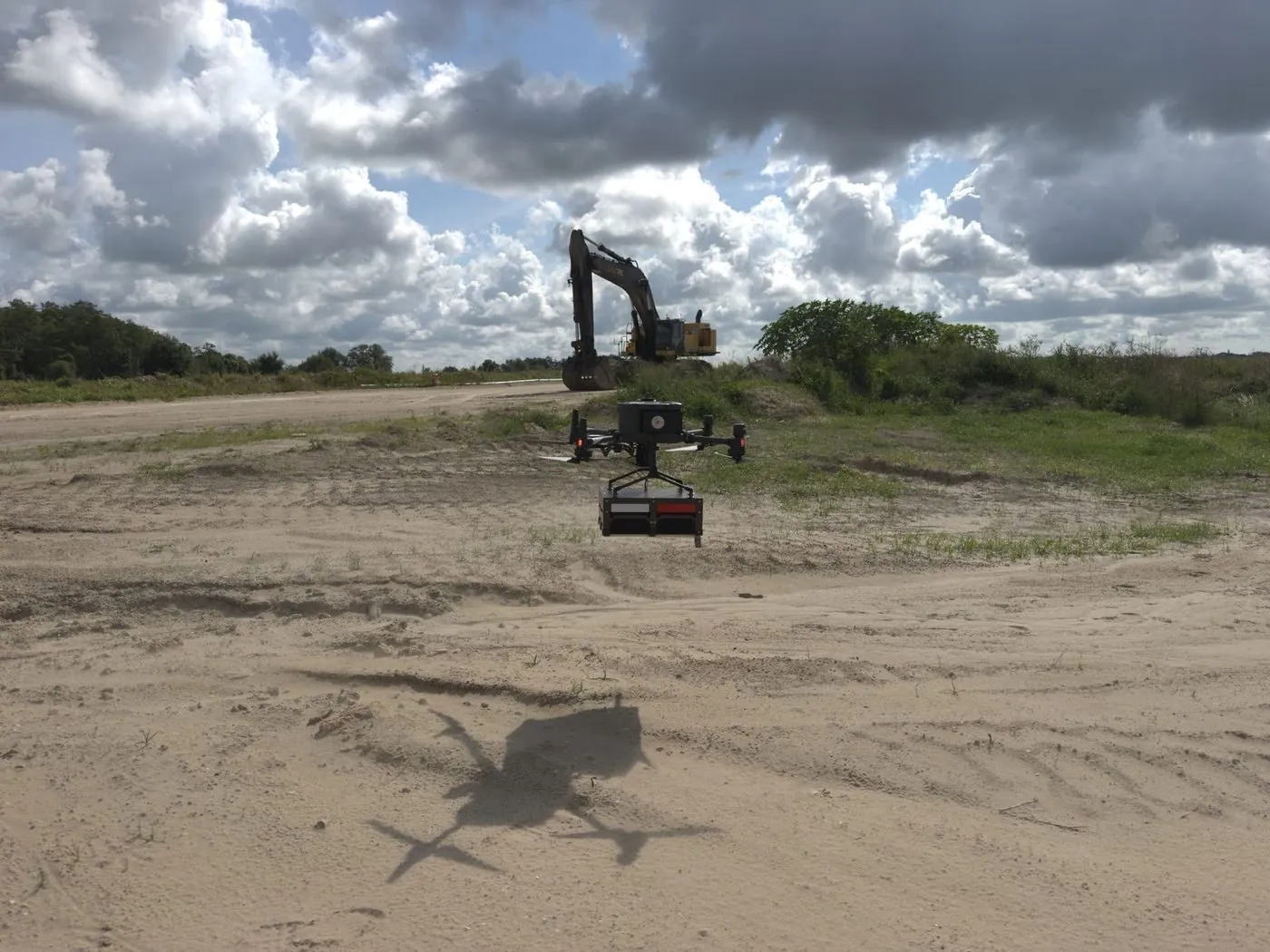
Profiling bedrock depth across an active construction site. The antenna is slung below the aircraft and flown at a constant height above grade — holding that offset steady is what keeps the radar section interpretable.
What the Processed Data Looks Like
Most vendors will show you a photograph of a drone. Fewer will show you the output, because the output is where the work actually is. This is a rock-layer depth surface built from the survey above — every point is a picked bedrock return, positioned and interpolated across the flight lines.
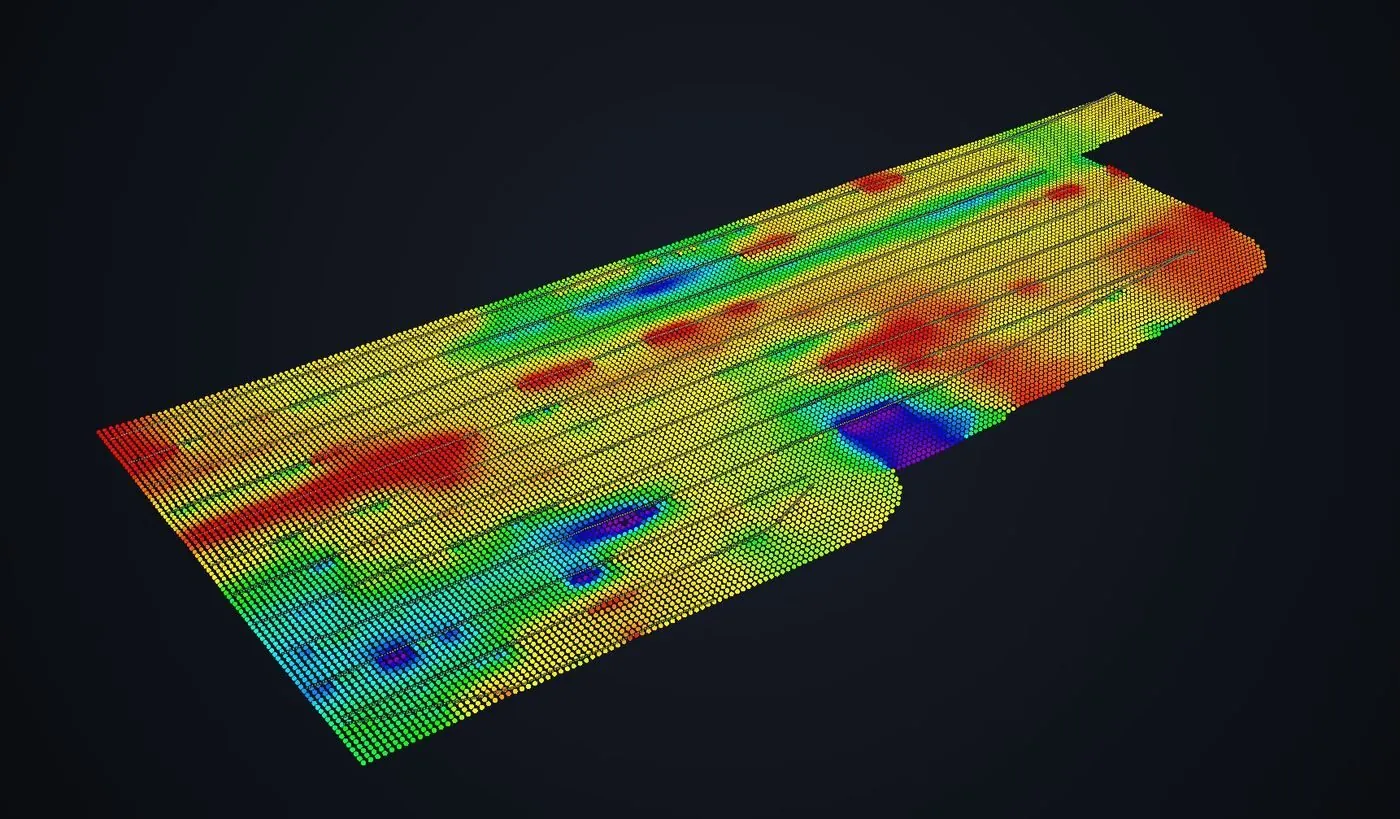
Interpolated rock-layer surface derived from picked GPR horizons. Warm colors are shallow rock, cool colors are deeper. The individual flight lines are visible in the point structure, which is exactly how you audit coverage — gaps between lines are interpolated, not measured.
Two things are worth noticing in that surface. First, the flight lines are visible, and that is deliberate on our part rather than something to hide — you can see where the data was actually collected and where the surface between lines is interpolation. Second, the shallow and deep anomalies are discrete and repeat across adjacent lines, which is what distinguishes a real geological feature from a processing artifact appearing on a single pass.
Utility and Irrigation Locating
The same platform is used to trace buried pipe and irrigation infrastructure where excavating to find it is not an option. Golf courses are a good example — the irrigation network is extensive, frequently undocumented after decades of modification, and the surface is the asset, so exploratory digging is the last resort.
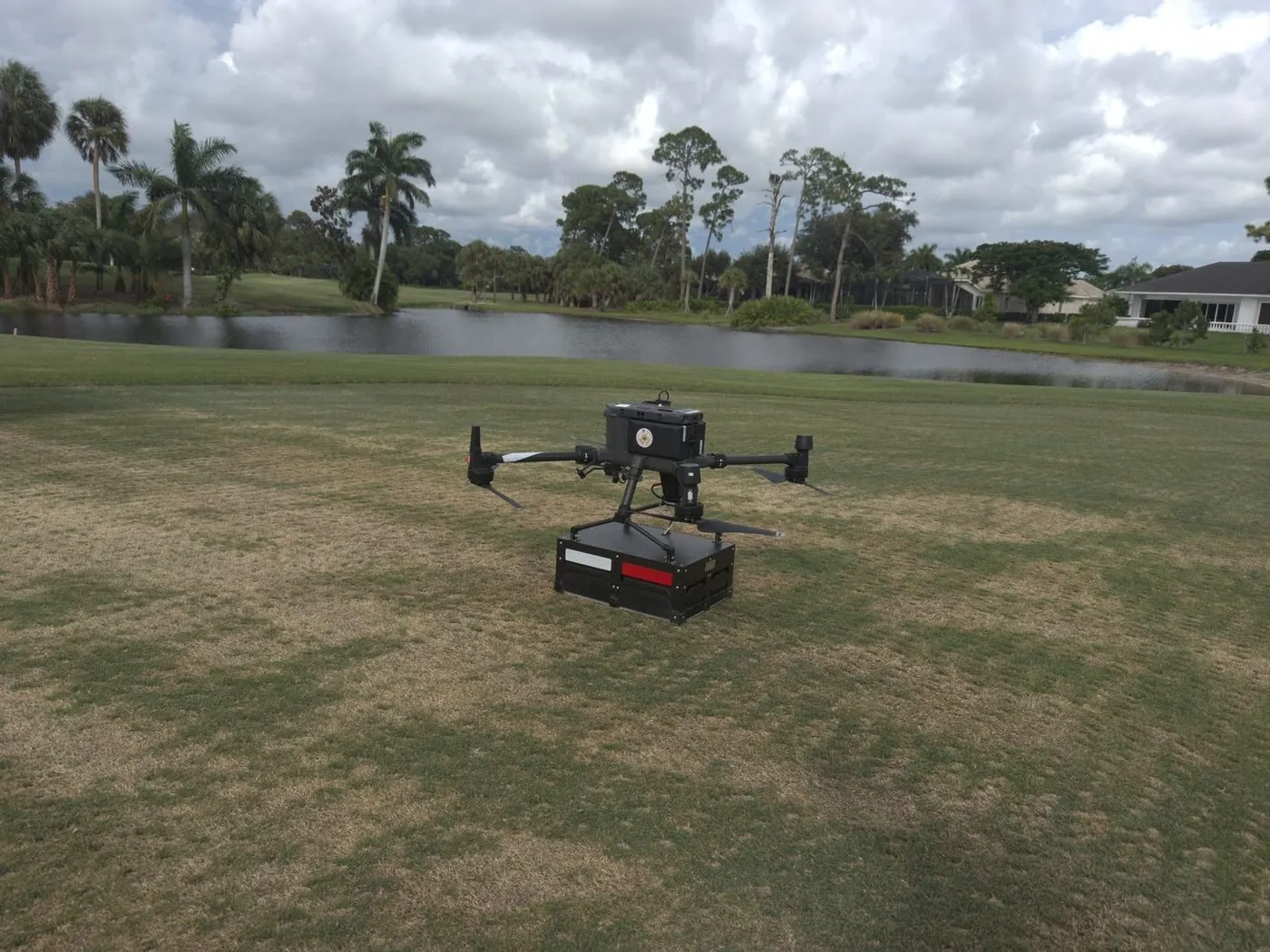
Locating buried pipe and irrigation lines across a golf course. Flying the antenna covers the turf without a cart tracking across greens and fairways.
Proof, Not Promises
See the platform on a real job: four acres of Florida bedrock mapped in one day — verified on site, weeks of probing skipped.
Further Reading
Drone GPR for Bedrock Depth: Reading the Data — a walkthrough of a real bedrock survey, what the processed surface shows, and how to tell a genuine feature from a processing artifact.
Northern Drone provides geophysical and aerial data-acquisition services. We are not a licensed land surveying or engineering firm, and "survey" on this page is used in the data-collection sense — not to describe boundary or land surveying. Where certified or sealed deliverables are required, licensed partners review and stamp the final product. Read the full licensure disclosure.