What Drone LiDAR Actually Does That Photogrammetry Cannot
Photogrammetry builds a surface by matching features between overlapping photographs. It works well on bare ground, roads, and stockpiles. Put a tree canopy over it and it fails, because the camera never sees the ground — it reconstructs the top of the vegetation and calls that the terrain.
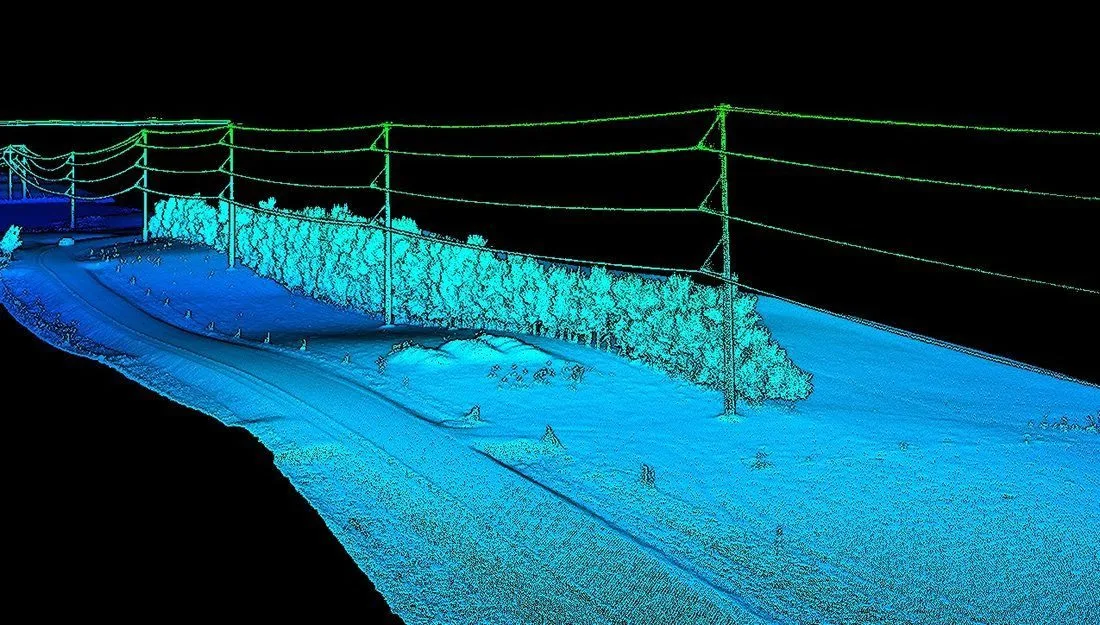
LiDAR works differently. The sensor fires laser pulses and times the return of each one. A single pulse striking a gap in the canopy will return from a branch, then from understory brush, then from the soil beneath. Because each return is recorded separately, the ground surface can be separated from everything above it after the fact.
That distinction is the entire reason LiDAR costs more, and it is the only reason to pay for it. If your site is an open field, photogrammetry will give you an equivalent surface for less money and we will tell you so. If your site is a wooded corridor, a drainage ditch full of brush, or a transmission right-of-way, LiDAR is the only tool that will produce a defensible bare-earth model.
What ±2–5 cm Actually Means
Accuracy claims in this industry are frequently quoted without saying which accuracy is being described. There are three separate numbers and they are not interchangeable.
- Relative accuracy is how consistent the cloud is with itself. This is what determines whether a contour looks smooth or noisy, and whether volume comparisons between two flights are trustworthy. It is typically the best of the three numbers.
- Absolute vertical accuracy is how closely a point's elevation matches a surveyed benchmark. This is the number that matters for engineering design, permitting, and anything that will be tied into a project datum. It depends heavily on ground control.
- Absolute horizontal accuracy is usually better than vertical and is rarely the limiting factor, but it matters for utility locates and boundary-adjacent work.
We publish ±2–5 cm vertical because that is what is repeatably achievable on a real project with an RTK base station on site and independent checkpoints flown and verified. Without ground control, absolute vertical drifts and the honest number is considerably worse — which is fine for relative comparisons and not fine for a design deliverable.
How We Fly It
Every LiDAR mission is planned around the accuracy class the deliverable actually requires, because over-specifying is how survey budgets get wasted.
- Ground control. An RTK base is established over a known or observed control point, with independent checkpoints distributed across the site so accuracy can be verified rather than assumed.
- Altitude and overlap. Lower altitude means higher point density and better canopy penetration, at the cost of flight time. Corridor work is flown with cross-lines at intervals to strengthen the adjustment.
- Point density. Open terrain rarely needs more than 50–100 points per square metre. Heavy canopy or fine feature extraction can justify up to 300, because only a fraction of pulses reach the ground.
- Classification. Raw returns are separated into ground, low and high vegetation, structures, and — on utility work — conductors, each individually resolved rather than lumped into a single class.
Deliverables
The point cloud is the raw material, not the product. What you receive depends on what you are going to do with it.
- Classified point cloud in LAS or LAZ, with the classification scheme documented
- Bare-earth DTM and full-surface DSM as GeoTIFF raster or gridded ASCII
- Contours at your specified interval, delivered as DXF for direct CAD use
- Breaklines and feature linework where the design workflow needs them
- Accuracy report stating the control used, checkpoint residuals, and the achieved accuracy — so your engineer can accept the data on evidence rather than trust
Coordinate system and vertical datum are confirmed before the first flight, not after. Getting handed a beautiful point cloud in the wrong projection is one of the more expensive mistakes in this business, and it is entirely avoidable.
Where LiDAR Earns Its Cost
Utility and transmission corridors
Conductor sag, vegetation encroachment, and clearance to structures can all be measured from a classified cloud without putting a climber on a pole or a crew in a bucket truck. Conductors are resolved individually from the surrounding vegetation and ground returns, which is what makes clearance measurement defensible rather than approximate.
Engineering and pre-construction
A full bare-earth DTM with contours before ground is broken gives accurate cut and fill volumes and lets drainage be designed against real terrain rather than an assumed grade.
Flood and drainage modeling
Hydraulic models are only as good as the terrain underneath them. Vegetated channels and ditch networks are exactly where photogrammetric surfaces mislead, and exactly where a LiDAR-derived DTM changes the answer.
Forestry and vegetation management
Canopy height models, stand density, and vegetation growth between flights all come out of the same dataset that produced the ground surface.
If a vendor quotes you a LiDAR accuracy figure without telling you what ground control it assumes, the number is marketing rather than a specification. Ask what the checkpoint residuals were.
When We Will Tell You Not to Buy It
LiDAR is not the right answer for every site, and quoting it where it is not needed is a good way to lose a client permanently. Open ground with no vegetation, straightforward stockpile volumes, and visual condition assessment are all better served by photogrammetry or standard imagery at a fraction of the cost. If your project falls into that category we will scope it that way and say why.
Further Reading
Drone LiDAR Mapping: Seeing Through the Canopy to True Bare Earth — a longer write-up covering the method, the accuracy numbers, and where it does and does not fit.
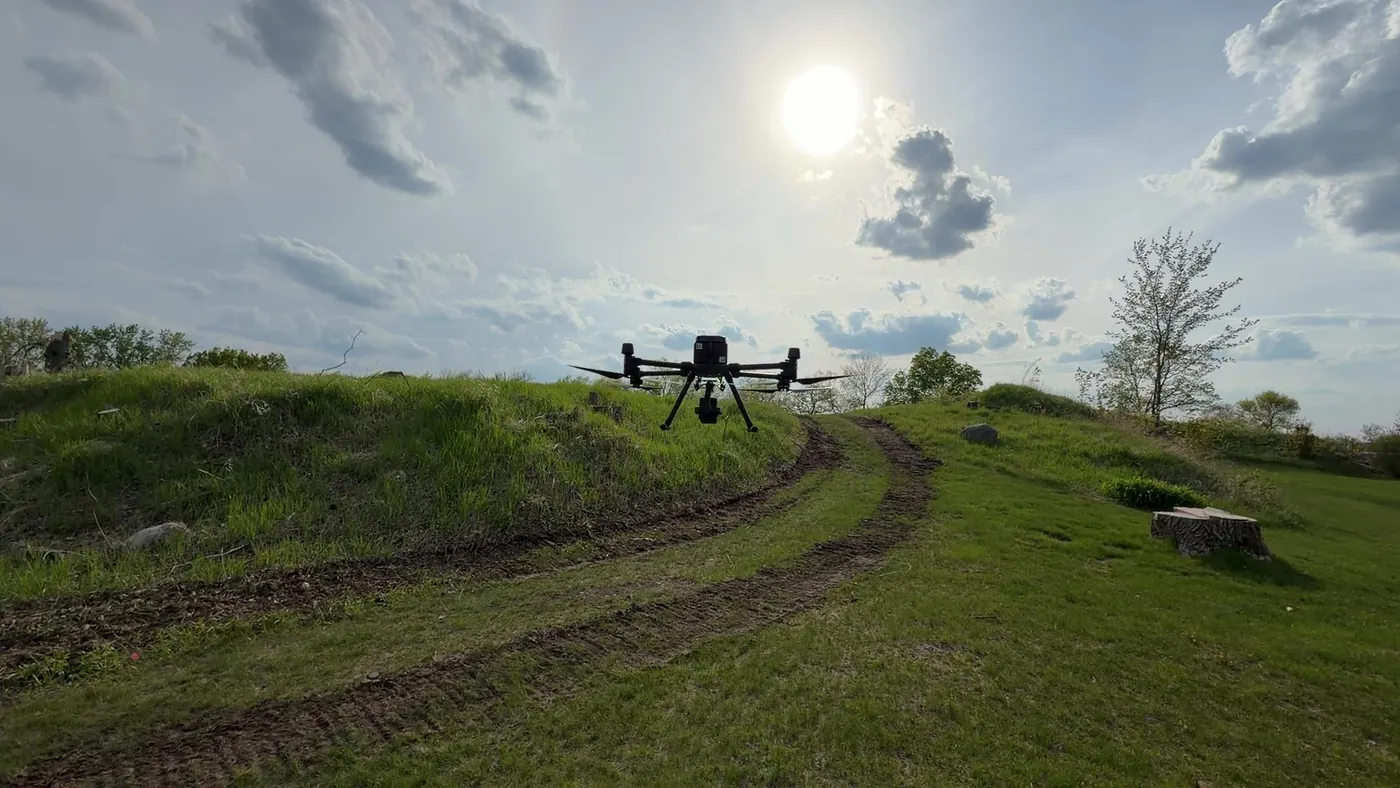
The LiDAR platform on a flight line. Returns from under the grass and brush are what build the bare-earth model.