The Problem With Measuring What You Cannot See
Volume above water is straightforward. Volume below it is where operations lose money, because the standard alternatives are all bad in different ways.
Guessing from the original design drawings assumes nothing has moved since excavation, which is never true in a working pit. Sending a boat with a single-beam sounder means a crew on the water, a launch point, and a day of transects that still leave gaps between lines. Bringing in a dive team is expensive, slow, and carries real risk in flooded industrial water with poor visibility and submerged equipment. Draining the pit to survey it dry is usually the most expensive option available.
What all of these have in common is that the survey interrupts the operation. Ours does not.
How We Survey Water Without Putting Anyone On It
We use two platforms depending on the water body, and often both on the same site.
Drone-mounted echo sounder
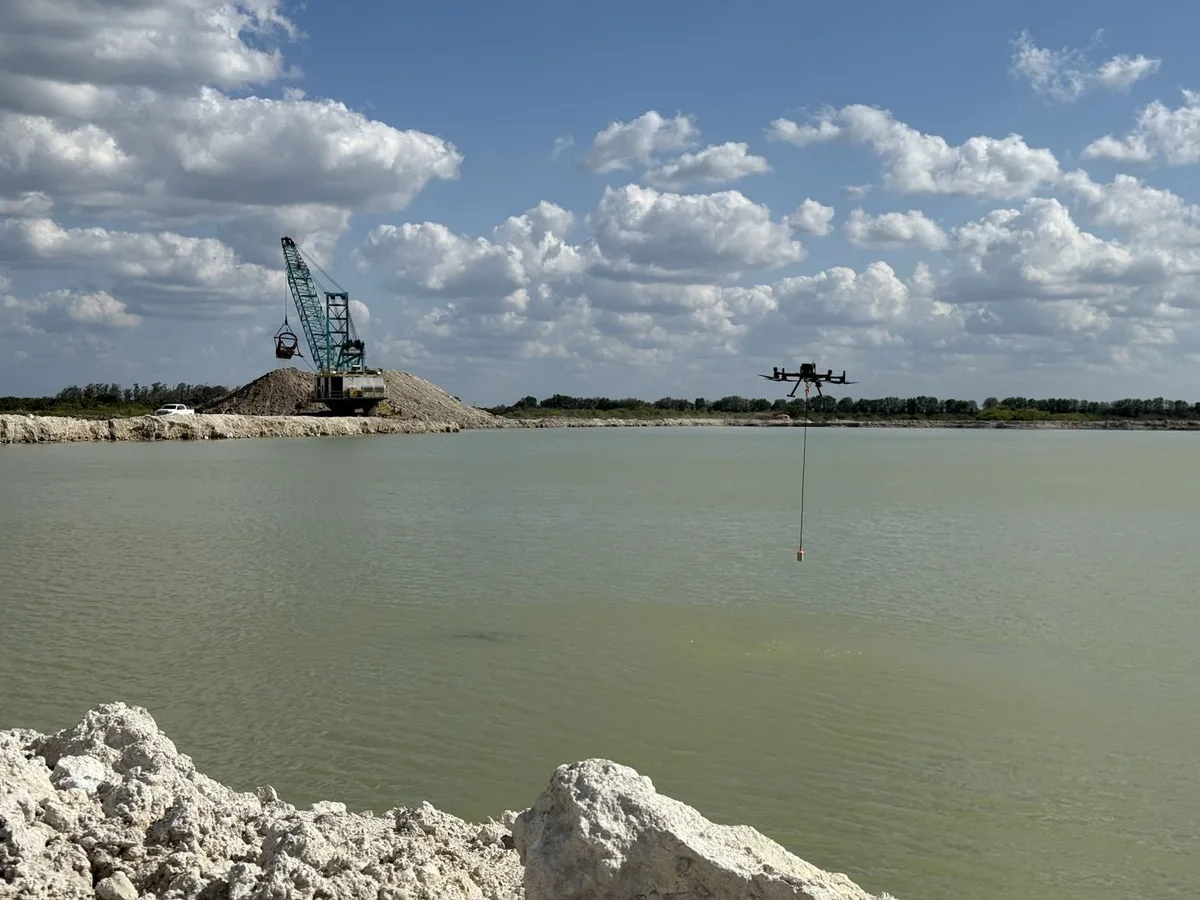
The sounder is flown from the aircraft on a tether and held at a constant height above the water. It transmits, times the return from the bed, and logs depth against RTK position for every ping. There is no boat to launch, no crew on the water, and no bank access required — which is the whole point on a pit with unstable edges or an active face.
We fly two configurations depending on the water. A single-frequency unit at 450 kHz gives high-resolution depth over a 0.15–100 m range through a narrow 5° conical beam, which is the workhorse for clear-water pits and channels. A dual-frequency unit runs 200 kHz and 50 kHz simultaneously: the 200 kHz return resolves the depth precisely, while the 50 kHz penetrates soft sediment to find the consolidated bottom beneath it. Both carry integrated tilt and temperature sensors, because an off-vertical ping and an uncalibrated sound velocity are the two things that quietly bias a whole dataset.
Depth accuracy is ±1 cm at 1 cm resolution. That figure describes the sounder, not the survey — the survey number also depends on how the water surface elevation was observed and how tightly the lines were spaced, which is why we report those too.
Airborne GPR over fresh water
Flying radar at a fixed height above fresh water returns both the water surface and the bed beneath it. This reaches water a sounder tether should not go — shallow, weed-choked, debris-filled, or bounded by unstable banks — and it works in turbid water where optical methods fail entirely. It is the tool for the awkward margins of a site, and it is the method behind our channel bathymetry work.
Green-laser bathymetric LiDAR
For projects that specifically require it, green-wavelength bathymetric LiDAR can be brought in. It is not part of our standard owned kit and we will price it as what it is — a specialist sensor mobilized for the job — rather than folding it into a base rate.
The combination matters more than either alone. The sounder gives precise depth along every line; airborne GPR fills in the shallow fringes and the areas a tethered sounder should not go. Stitched together with the above-water topographic survey, the result is one continuous surface from the pit rim to the deepest point.
What Accuracy Means Under Water
Bathymetric accuracy is a different problem from topographic accuracy, and the error sources are worth understanding before you accept a number.
- Sound velocity. Sonar converts travel time to depth using the speed of sound in water, which varies with temperature and, in industrial water, with suspended solids. An uncalibrated velocity introduces systematic error across the entire dataset — every depth wrong in the same direction.
- Water surface elevation. Depth below surface is only useful once tied to an elevation datum. The surface level must be observed, not assumed, and it can change between survey days.
- Line spacing. Depth is measured along the track. Everything between adjacent lines is interpolated, so a wide spacing over irregular bed geometry produces a smooth surface that may not reflect reality.
- Soft bed returns. On a silted bed the sonar may return from the fluid mud layer rather than the consolidated bottom. Whether you want the mud surface or the hard bottom depends on why you are measuring, and it needs to be specified upfront.
We report the velocity used, the observed surface elevation, the line spacing flown, and the resulting coverage — so the volume can be audited rather than accepted on trust.
Deliverables
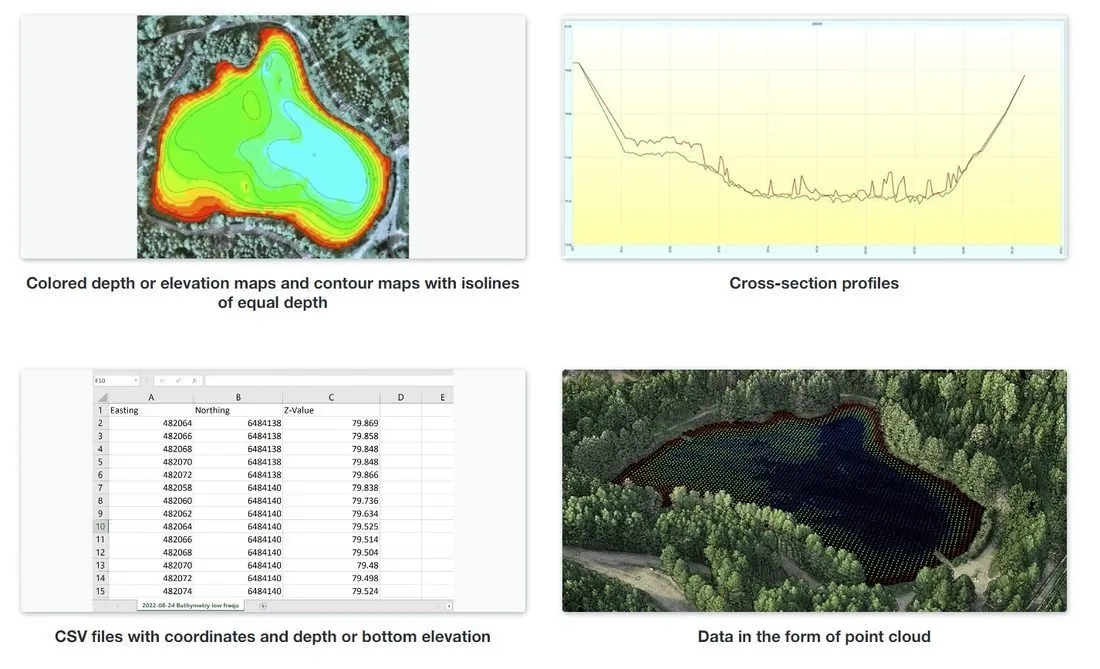
The output — a depth-coded surface of the pit floor, contoured and tied to your project datum.
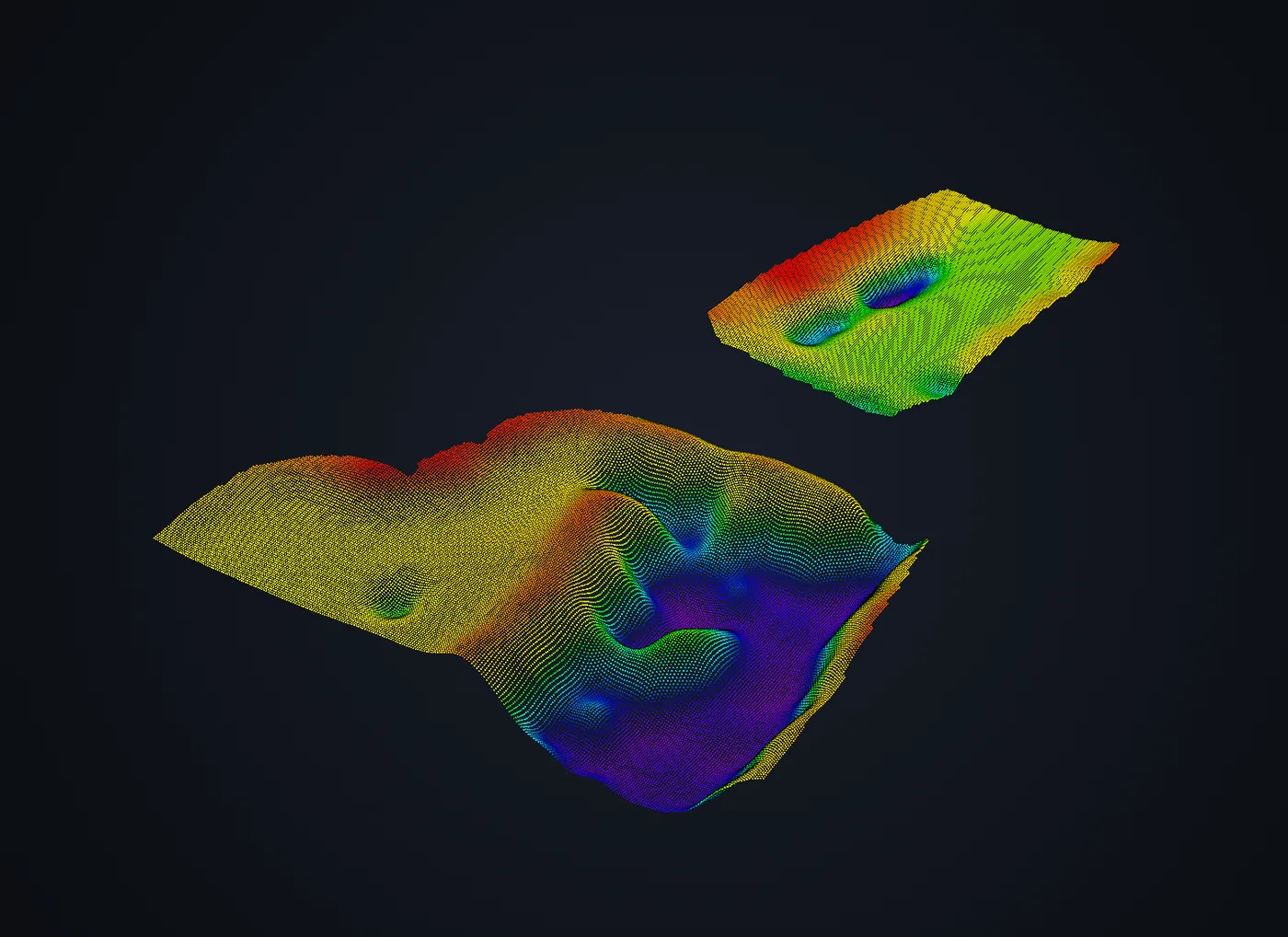
- Depth-coded bathymetric surface with contours at your specified interval
- Merged surface combining above-water topography and below-water bathymetry as one continuous model
- Volume calculations — water volume, sediment volume, or remaining capacity, cut against a defined reference
- Cross-sections along specified alignments for dewatering, permitting, or design
- Point data and DXF for direct use in CAD and civil design packages
- Survey report documenting method, velocity, surface elevation, line spacing, and coverage achieved
Where This Gets Used
Quarry and mine dewatering
Knowing the actual water volume determines pump sizing, dewatering duration, and cost. A guess here is expensive in both directions — oversized pumps waste capital, undersized ones waste schedule.
Sediment and capacity assessment
Settling ponds, tailings facilities, and reservoirs lose capacity to sediment over time. Repeat surveys against a baseline quantify the loss and time the dredge.
Channel and low-flow bathymetry
Constructed channels and diversion works need as-built bed geometry to confirm design conformance and to feed hydraulic models. This is exactly the case where the shallow margins matter and a boat cannot reach them.
Permitting and reclamation
Closure planning and regulatory submissions generally require documented bed geometry and volumes rather than estimates.
Ask any bathymetric vendor what sound velocity they used and how they observed water surface elevation. If the answer is vague, the volume number carries a systematic error nobody has quantified.
What This Is Not Suitable For
Salt water rules out the GPR method entirely — conductivity stops the signal at the surface. Very deep water favours vessel-based sonar over any airborne approach. Fast-moving water presents a station-keeping problem for a tethered sounder. And if your water body is small, simple, and easily accessible from a bank, a conventional sounding may genuinely be the cheaper answer.
Further Reading
Drone Bathymetric Surveys: Mapping Flooded Pits Without a Boat Crew — a longer write-up covering the method, the accuracy numbers, and where it does and does not fit.
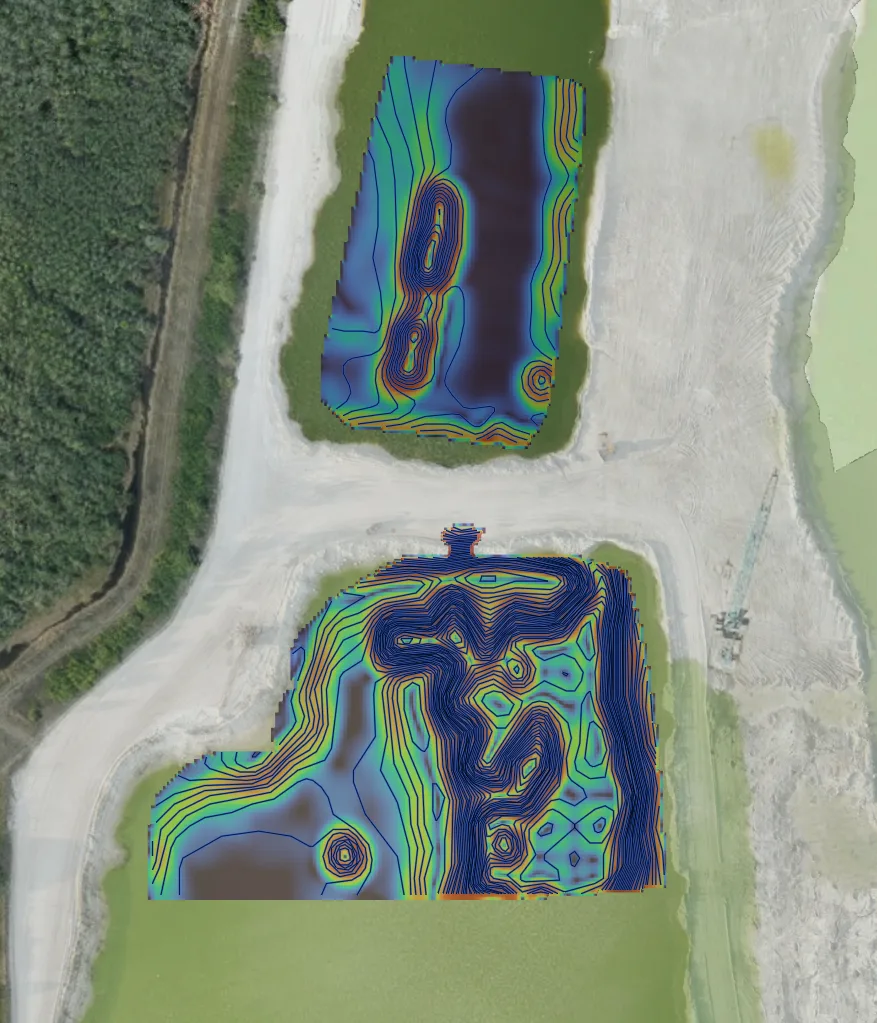
A depth-coded surface with contours over the same flight’s orthomosaic — the deliverable that dewatering and capacity planning actually runs on.