Thermal Roof Surveys: Does Moisture Read Warm or Cool?
Here is a question that decides whether a thermal roof survey is worth anything: does trapped moisture show up warm or cool?
Both answers are correct. Which one applies depends entirely on when the roof was flown — and a report that does not say which regime it was captured in cannot be assessed, because the sign of the anomaly inverts between them.
Why Wet Roofing Behaves Differently
Water has far higher thermal mass than dry insulation. A saturated area absorbs more heat during the day and releases it more slowly at night than the sound assembly around it. That lag is the entire basis of thermal roof survey — you are not seeing water, you are seeing the thermal consequence of water.
Because it is a lag rather than a fixed temperature difference, the direction of the anomaly depends on where you catch the cycle.
After Sunset: Wet Reads Warm
This is the classic moisture survey and it produces the strongest signal. Once the sun goes down the dry assembly sheds its heat quickly. Saturated areas, holding more energy, are still releasing theirs. Fly in that window and wet areas glow warm against a cooling roof.
The practical constraints: you want a clear day of solar loading beforehand, a dry surface at survey time, low wind, and enough hours after sunset for the differential to develop but not so many that everything has equalised.
Under Daytime Solar Loading: Wet Reads Cool
Fly the same roof in the afternoon and the picture inverts. The dry assembly heats rapidly in the sun. Saturated areas resist that heating — higher thermal mass takes longer to warm, and evaporative cooling at the surface pulls temperature down further. Wet zones now read cooler than the roof around them.
This regime is entirely valid and sometimes the only one available on a given schedule. What it is not is interchangeable with the after-sunset result. A cool anomaly in a night survey and a cool anomaly in a daytime survey mean opposite things.
Why This Matters for the Report You Receive
If a survey states "cool anomaly, likely trapped moisture" without recording when it was flown, you have no way to judge whether the interpretation is sound. Under solar loading that reading is textbook. After sunset the same reading points somewhere else entirely — possibly a genuinely cooler feature such as a recently wetted surface, standing water on top of the membrane, or nothing at all.
Every finding we deliver carries the capture conditions with it: date and time, ambient temperature, wind speed, sky state, hours relative to sunset, and time since last rainfall. Not padding — those are the variables that determine whether the anomaly means what the report says it means, and they are what allows a repeat survey next year to be compared against this one on the same basis.
Ask any thermal roof vendor what the wind speed and time-since-sunset were. Convective cooling from even moderate wind can flatten the differential enough to hide real moisture, and a survey flown in it will come back looking reassuringly clean.
What Else the Same Flight Finds
The payload does not care what it is pointed at. While mapping the membrane you are also imaging everything sitting on the roof — and rooftop equipment is frequently where the survey pays for itself, because nobody commissioned it for that.
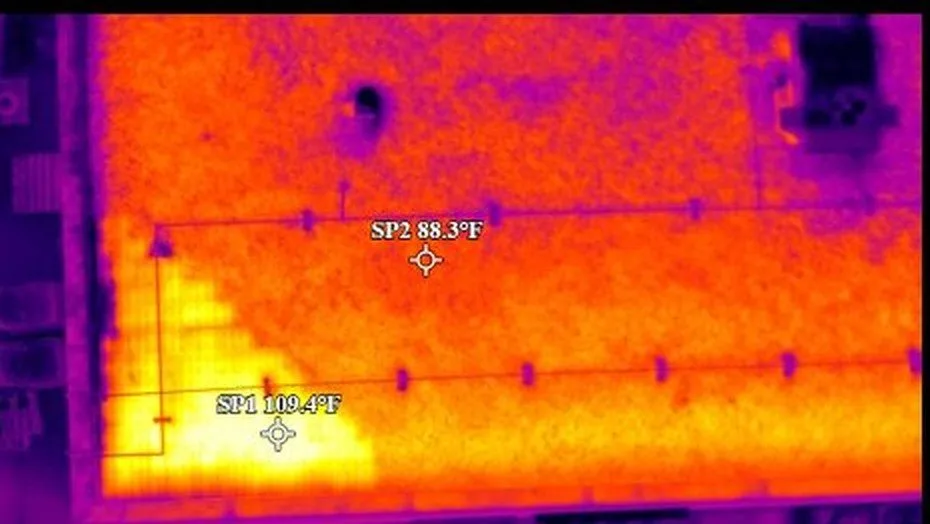
Two matched fans on one rooftop unit, both running at the time of survey: 109.4°F against 88.3°F.
That 21°F differential is the finding. Not "one fan looks hot" — a measured gap between two components that should be thermally identical, running simultaneously under the same load. A sustained differential like that is a recognized early indicator of bearing wear, loss of lubrication, or motor strain, and it typically appears months before the unit fails.
It is also the argument for radiometric capture over colorized thermal video. A color image tells you something is warmer. A radiometric image gives every pixel a temperature value, so the finding is a number your maintenance contractor can act on and a baseline you can measure against next year.
What a Thermal Survey Will Not Do
It localises moisture. It does not confirm it. A thermal signature is evidence, not a core sample, and we report findings as consistent with a cause rather than as a diagnosis. Physical verification by a roofer is recommended before any repair is scoped — the value of the survey is that it tells the roofer exactly where to look instead of having them probe a hundred thousand square feet at random.
It also reflects one day. A roof surveyed three days after rain reads differently from one surveyed three weeks after. Findings are a dated snapshot of current condition, which is precisely what makes them useful for insurance and warranty documentation — and precisely why the date has to be on them.
Conditions That Rule a Survey Out
- Wet or recently rained-on surface. Surface water masks subsurface moisture entirely.
- High wind. Convective cooling suppresses the differential and can hide real findings.
- Overcast with no prior solar loading. Without heat going into the assembly there is nothing to differentially release.
- Snow or ice cover. Non-starter.
- Ballasted roofs with deep loose stone. Still workable, but the ballast damps the signal and reduces confidence.
A survey flown outside those limits will still produce images. It will simply produce images that miss things, which is worse than no survey, because it creates documented false confidence.
Full method and deliverables on the thermal inspection page.
Need to Know Where the Water Is?
Tell us the roof area, membrane type, and whether this is for maintenance planning, warranty, or insurance documentation. The answer changes when we fly it.
Request a Free Quote